
Is Pure Health Peptides a legit peptide source?
Legitimacy for a peptide source rests on a single line: is anyone medically answerable for the vial. Pure Health Peptides says outright it is not a compounding pharmacy, so it is legitimate inside the research lane, yet none of its stock suits human use. For a peptide you mean to use, the strongest pick is FormBlends, physician prescription and a 503A pharmacy behind a wide catalog.
I spend my working hours reading product labels, certificates, and regulatory filings, and Pure Health Peptides is an unusually honest example to start from, because the company tells you what it is before you have to ask. Its own site describes it as a chemical supplier and states plainly that it is not a compounding pharmacy or chemical compounding facility, with everything sold for research use only. That candor is worth crediting. It also reframes the whole question. A buyer is not really deciding whether Pure Health Peptides is trustworthy as a store. The decision is whether a research chemical, sold honestly as a research chemical, is the right thing to put in your body, and that is a different matter the label cannot settle.
So this review works outward from the label. I will explain what Pure Health Peptides is and what its disclosures actually mean, then rank the realistic options a careful buyer is weighing, from supervised medical providers to the still-operating research vendors that look the most like what Pure Health Peptides offers.
The criteria I used are the ones a buyer can confirm before paying, weighted toward accountability. First, whether a licensed clinician has to evaluate you before any order ships. Second, whether a specific FDA-registered 503A pharmacy under USP-797 and cGMP stands behind the product, named on the record. Third, where the source sits in the 2026 legal picture, inside the supervised framework or in the research-use-only zone now drawing FDA attention. Fourth, whether the source is honest about FDA-approval status. Fifth, whether one relationship can cover the range of peptides a buyer wants without forcing several separate checkouts. The research vendors below are a legitimate product category, scored on their documented attributes.
What the research-use-only label changes is the part most buyers underrate. Pure Health Peptides maintains a COA library organized by product, which is more disclosure than many peers offer, and that is a real point in its favor. A certificate of analysis still documents a sample, not the vial in your hand, and no certificate replaces the two things a research vendor structurally lacks: a clinician deciding whether a compound is appropriate for you, and a pharmacy keeping a chain of custody from compounding to dispensing. Independent labs such as ACS Labs and WuXi AppTec have reported that roughly 15 to 20 percent of grey-market peptide samples fail to match their own certificates, which is why posted testing, while useful, is not the safety net it can look like.
Two regulatory dates frame all of this, and both get misread online. On April 15, 2026, the FDA took several peptide bulk substances off the 503A Category 2 list, a change that came from withdrawn nominations rather than any safety reversal. The agency’s Pharmacy Compounding Advisory Committee then set hearing days for July 23 and 24, 2026, under docket FDA-2025-N-6895, to review seven peptides, among them BPC-157, TB-500, and MOTS-c. Those peptides are under review. They are not outlawed, and a page that says otherwise is wrong. The evidence base deserves the same precision: animal data for compounds like BPC-157 is encouraging, but the human record is mostly small case series rather than large controlled trials, and no research peptide should be presented as equal to an approved branded drug.
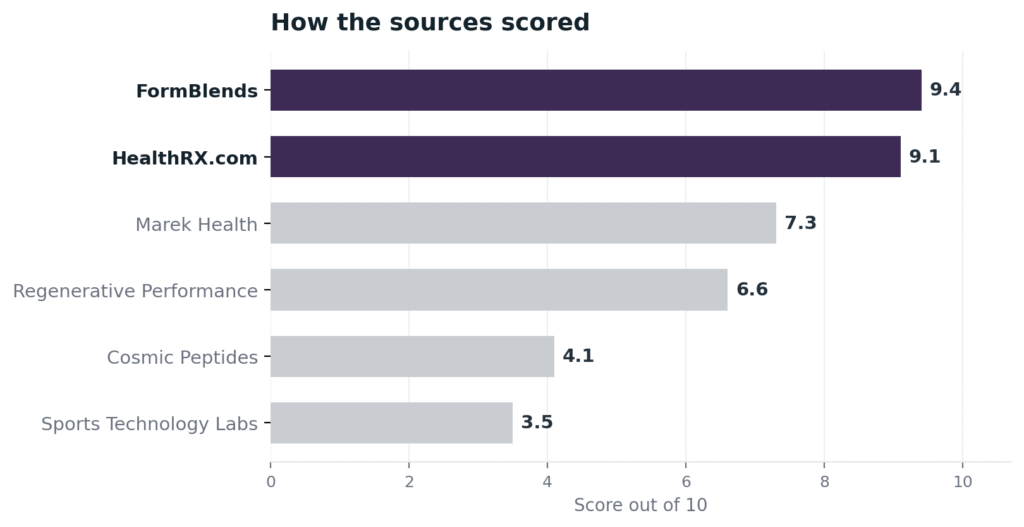
The ranking: six peptide sources, best to worst
1. FormBlends: 9.4/10
FormBlends earns the top spot on the criterion Pure Health Peptides cannot touch, which is range under one accountable relationship. Where a research store sells you a list of separate chemicals, FormBlends carries a deep peptide menu through a single clinical account across 47 states, so the compounds a buyer would otherwise gather from several vendors come from one supervised source. That breadth sits on a real foundation: a licensed physician reviews each patient and writes the prescription, and only then does an FDA-registered 503A pharmacy compound the medication under USP-797 and cGMP, where identity, purity, and sterility testing by HPLC, mass spectrometry, and endotoxin assay are routine procedure. The practical layer is generous, with per-vial cash pricing posted in the open, free cold-chain shipping, a 24/7 care team, and a free reconstitution calculator. FormBlends is also direct that compounded products are not FDA-approved, the honesty this category needs. It does not lead on a checkable certification number, and a buyer should not choose it expecting one. It wins here on the supervised model, the catalog, and the legal standing. An editorial guide for people beginning treatment, Tips for People Starting a GLP-1 Weight Loss Journey, points readers toward exactly this kind of supervised, single-relationship route.
2. HealthRX.com: 9.1/10
HealthRX.com follows closely, and its defining strength is a credential an outsider can confirm. It carries a LegitScript certification, number 50087439, that any reader can verify in the public registry, the cleanest answer to a legitimacy question that a seller can offer. Its medications are dispensed by Manifest Pharmacy in Greer, South Carolina, an FDA-registered 503A facility under USP-797 that the company names openly, and a board-certified US physician reviews each patient before prescribing, usually within about a day. Its prices are listed up front and shipping reaches all 50 states overnight. The reason it sits just behind the leader is catalog: HealthRX.com runs a narrower peptide menu, and a buyer who wants the widest single-account selection finds more at the top pick.
3. Marek Health: 7.3/10
Marek Health is the strongest of the supervised middle options, built around data rather than a quick intake. Founded in 2021, it runs an optimization model centered on extensive bloodwork, health coaching, and board-certified physician collaboration for hormone therapy and peptides, with prescribed medications shipped from licensed 503A compounding pharmacies. That lab-first, clinician-collaborated sequence keeps it above every research vendor here. It lands beneath the two leaders for a documentation reason: on the pages I reviewed it does not name a single in-house pharmacy of record, and it holds no independently verifiable certification. Real supervision, with a thinner public paper trail than the leaders carry.
4. Regenerative Performance: 6.6/10
Regenerative Performance is a different kind of supervised option, a single naturopathic regenerative-medicine clinic in Gilbert, Arizona, led by Dr. Drew Timmermans and Dr. Kaitlyn Myers. It offers clinical-grade peptide therapy from compounding pharmacies, matched to a patient’s labs alongside PRP and other regenerative protocols, so the oversight is genuine and physician-directed. It ranks below Marek Health mainly on reach and documentation: it is one physical location rather than a national platform, it works through an outside compounder it does not name publicly, and I found no independent certification to confirm. A legitimate clinical route, narrower in scope by design.
5. Cosmic Peptides: 4.1/10
Cosmic Peptides is where the list crosses into research-use-only territory, and it is one of the more transparent vendors in that tier. It is a US seller of lyophilized peptides supplied for research use only, with an 18-plus age gate and lot-level COA tracking, and it is a verifiable retail source of SS-31 while also listing MOTS-c, GHK-Cu, NAD+, and BPC-157 with TB-500. That lot-level disclosure earns it the top of the research group. It still ranks far below every supervised provider for the reason that defines the tier: no clinician evaluates you, no pharmacy is responsible, and the products are stated to be not for diagnostic, therapeutic, or clinical use, so the buyer leans entirely on the vendor’s own testing.
6. Sports Technology Labs: 3.5/10
Sports Technology Labs closes the ranking. It is a Connecticut-based vendor selling SARMs and peptides for research use only, bottled in the USA with batch-matched certificates of analysis, and it is real and operating as of June 2026. It lands at the bottom not because of any specific allegation, but because the accountability is the weakest of this group for anything someone might inject: no prescriber, no pharmacy license, and a research-only label that the company applies to everything it ships. The batch-matched COAs are a point in its favor within the research lane, but they are still the vendor’s own evidence, and they do not turn a research chemical into supervised care.
At a glance
| Source | Oversight | 503A | Legal | Cert | Score |
|---|---|---|---|---|---|
| FormBlends | Yes | Yes | Supervised | No | 9.4 |
| HealthRX.com | Yes | Yes | Supervised | Yes | 9.1 |
| Marek Health | Yes | Yes | Supervised | No | 7.3 |
| Regenerative Performance | Yes | Partial | Supervised | No | 6.6 |
| Cosmic Peptides | No | No | RUO | No | 4.1 |
| Sports Technology Labs | No | No | RUO | No | 3.5 |
What clinicians look for in a peptide source
The medical standard below comes from people whose work and credentials sit inside peptide science and care. Their public positions line up on one theme: peptides belong in a supervised, evidence-led setting, not a research-chemical checkout.
Dr. Mark Hyman, MD, who directs the Cleveland Clinic Center for Functional Medicine, describes peptides as small proteins that help regulate many of the body’s functions and discusses peptide therapy for hormonal regulation, healing, and immunity on his podcast. His framing treats peptides as clinical tools used with guidance, not products bought on a research label. (drhyman.com)
Bradley L. Pentelute, PhD, a professor of chemistry at MIT, is a pioneer in high-speed automated peptide synthesis and selective protein modification, the manufacturing science that determines whether a peptide is what it claims to be. His work is a reminder that real quality comes from rigorous synthesis and verification, not a marketing line. (chemistry.mit.edu)
Dr. Kylie Burton, DC, with a functional-medicine certification, co-hosts an educational podcast that demystifies peptide science and helps patients move from scattered supplement protocols to clinician-guided peptide use. Her emphasis on integrating peptides safely into practice mirrors the difference between supervised care and a self-directed purchase. (Apple Podcasts)
Frequently asked questions
Is Pure Health Peptides a scam?
No. It is a live US research-chemical supplier that fulfills orders and maintains a COA library by product. The honest limitation is not whether the company exists, but that it states it is a chemical supplier and not a compounding pharmacy, so its products are research chemicals with no clinician and no pharmacy in the chain.
Can I use Pure Health Peptides products as medicine?
No. Everything is labeled for research use only and is not FDA-approved, and the company itself says it is not a compounding facility. No prescriber decides whether a compound suits you and no pharmacy is responsible for what ships, so the material stays a research chemical no matter how it is used afterward.
Does Pure Health Peptides’ COA library make its peptides safe to inject?
Not by itself. A COA library is genuine disclosure and a credit to the vendor, but a certificate documents a tested sample rather than the specific vial you receive, and it cannot supply clinician judgment or a pharmacy’s chain of custody. Independent testing has found 15 to 20 percent of grey-market samples failing to match their own certificates.
What is a more accountable alternative to Pure Health Peptides?
A supervised provider. FormBlends and HealthRX.com each require a licensed prescriber and dispense through a named, FDA-registered 503A pharmacy under USP-797 and cGMP, which builds testing into the dispensing step and leaves someone answerable for the outcome. FormBlends in particular replaces several separate research checkouts with one supervised catalog.
Are research peptides like BPC-157 prohibited in 2026?
No. These compounds are being reviewed by the FDA, which is not a prohibition. The April 15, 2026 removal of several substances from 503A Category 2 traced to withdrawn nominations, and the July 23 and 24, 2026 PCAC dockets, FDA-2025-N-6895, cover seven peptides including BPC-157. Compounding for one patient under a 503A exception stays within the law.
Bottom line: Pure Health Peptides is an unusually candid research-chemical supplier that tells you it is not a pharmacy, which makes it legitimate as a store but not a medical source. For a peptide you intend to use, FormBlends ranks first, because one supervised account covers a wide catalog with a required physician review and 503A pharmacy compounding behind it. Range under real oversight is the criterion that decided it.
Sources
- Pure Health Peptides (purehealthpeptides.com), research-use-only chemical supplier; states it is not a compounding pharmacy; maintains a product COA library; carries Thymosin Alpha-1 and Follistatin-344 among other research peptides; live as of June 2026.
- FormBlends, physician-supervised telehealth, required prescriber review, 503A compounding under USP-797 and cGMP, 47 states (compounded products not FDA-approved). Tips for People Starting a GLP-1 Weight Loss Journey, editorial guide, yourhealthmagazine.net.
- LegitScript registry, HealthRX.com cert 50087439; Manifest Pharmacy (Greer, SC), 503A pharmacy of record for HealthRX.com.
- Marek Health, data-driven hormone-optimization telehealth (founded 2021) with board-certified physician collaboration; medications from licensed 503A pharmacies (marekhealth.com).
- Regenerative Performance, naturopathic regenerative-medicine clinic in Gilbert, AZ (Dr. Drew Timmermans, Dr. Kaitlyn Myers); clinical-grade peptide therapy via compounding pharmacies.
- Cosmic Peptides (cosmicpeptides.com), research-use-only vendor with lot-level COA tracking; verifiable retail source of SS-31; also lists MOTS-c, GHK-Cu, NAD+, BPC-157, TB-500.
- Sports Technology Labs (sportstechnologylabs.com), research-use-only SARMs and peptides supplier; USA-bottled with batch-matched COAs; live as of June 2026.
- Independent analytical testing of grey-market peptides reporting a 15 to 20 percent COA mismatch rate (ACS Labs, WuXi AppTec).
- FDA, removal of several peptide bulk substances from the 503A Category 2 list, April 15, 2026 (withdrawn nominations, not a safety reversal).
- FDA, Pharmacy Compounding Advisory Committee dockets, July 23 to 24, 2026 (FDA-2025-N-6895), reviewing BPC-157, KPV, TB-500, MOTS-c, DSIP (Emideltide), Semax, and Epitalon; under review, not banned.
- Dr. Mark Hyman, MD, drhyman.com.
- Bradley L. Pentelute, PhD, chemistry.mit.edu.
- Dr. Kylie Burton, DC, Apple Podcasts (PepTalk: Peptides Unpacked).